
How to Read Tire Sizes: A Beginner’s Guide for Off-Road Enthusiasts
If you're new to off-roading, upgrading your tires is one of the first steps to improving performance on rough terrain. However, understanding tire sizes can be confusing at first glance. What does something like 285/70R17 mean? And more importantly, how do you make sure that the size fits your vehicle?
At Rowell’s, we prioritize proper fitment and only offer products we trust and stand behind. This guide breaks down how to read tire sizes so you can make smart decisions without risking a bad fit.
Understanding Tire Size Numbers
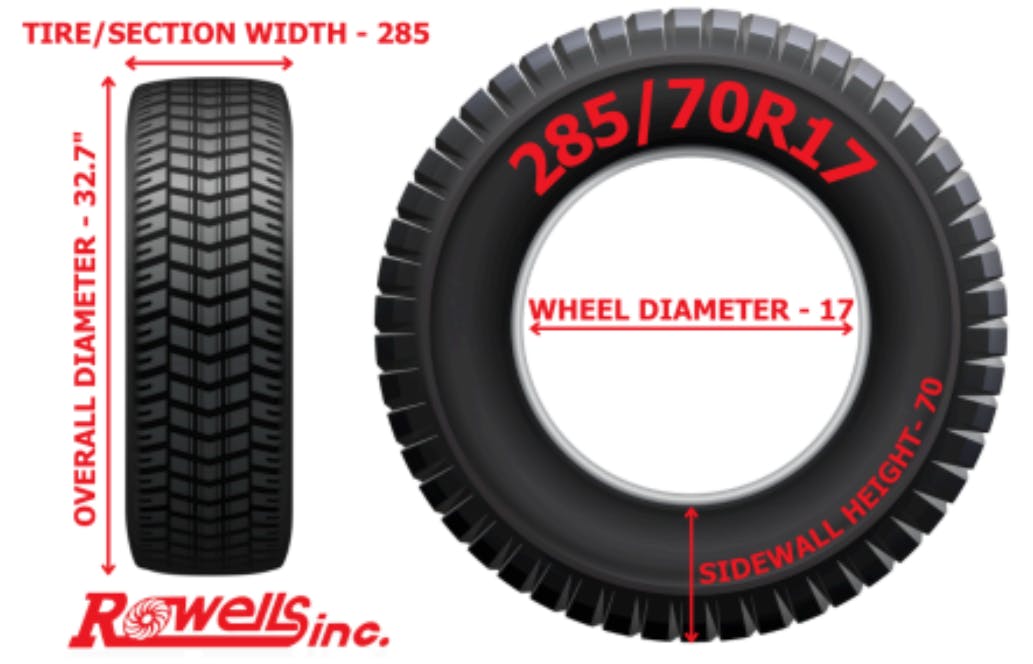
Let’s take 285/70R17 as an example.
- 285 – Tire width in millimeters
- 70 – Aspect ratio (sidewall height is 70% of the width)
- R – Radial construction
- 17 – Wheel diameter in inches
A 285/70R17 tire is 285mm wide, has a sidewall height that is 70% of that width, and fits a 17-inch wheel.
Why Tire Fitment Is Critical
Reading the numbers is only part of the equation. Not every tire size works with every off-road build. Even a slight miscalculation can lead to rubbing, reduced clearance, poor handling or drivetrain issues.
Rowell’s eliminates that guesswork. The brands we carry are carefully selected for reliable fitment and vehicle compatibility. Our team ensures your upgrades work the way they should. If there’s ever an issue, we’ll make it right. That’s how we back our products and our service.
Common Tire Upgrade Mistakes to Avoid: Pro Tips for Better Fitment
- Pro Tip 1: Check for Suspension or Fender Modifications
- Going up even one or two tire sizes may require trimming fenders or installing a lift or leveling kit. Always confirm clearance before mounting your new tires.
- Pro Tip 2: Don’t Skip the Spare
- A larger spare is just as important as your four main tires. A mismatched spare could damage your driveline or throw off traction control in a 4WD system.
- Pro Tip 3: Bigger Tires May Require Regearing
- Installing larger tires changes your gear ratio and can reduce torque and fuel economy. Talk to one of our experts to see if a regear is recommended.
- Pro Tip 4: Consider Load Ratings
- Tire size isn’t the only thing that matters. Make sure your tires can handle the weight of your gear, passengers and any towing or hauling.
- Pro Tip 5: Think About Ride Comfort
- Aggressive off-road tires can get loud and rough on pavement. If your vehicle is also a daily driver, find a balance between performance and comfort.
- Pro Tip 6: Always Air Down With the Right Tools
- Running low tire pressure off-road increases traction, but only if done safely. Use a high-quality tire pressure gauge and carry a portable air compressor to reinflate after the trail.
- Running low tire pressure off-road increases traction, but only if done safely. Use a high-quality tire pressure gauge and carry a portable air compressor to reinflate after the trail.
Metric vs. Flotation Sizing
Off-road tires sometimes use a different sizing method, called flotation sizing. For example, 35x12.50R17 breaks down like this:
- 35 – Overall height of the tire in inches
- 12.50 – Width of the tire in inches
- R17 – Tire fits a 17-inch wheel
Both formats are common in off-road applications, so understanding each will help you compare options accurately.
Pro Tip:
A common mistake is confusing wheel diameter with the tire’s overall diameter. Don’t assume a 17-inch wheel means the entire tire is 17 inches tall—it only refers to the wheel diameter, not the overall tire diameter. Always check your vehicle’s clearance before switching to a larger size.
How to Calculate Overall Tire Diameter
To find the overall diameter of a tire, you need to measure more than just the wheel. You’re adding the height of the rubber sidewall above the wheel and below it, plus the wheel itself.
Here’s the easy way:
- Start with the tire’s width (the first number)
- Multiply it by the aspect ratio (the second number, as a percent). That gives you the height of one sidewall
- Double that number (since there’s a sidewall on top and bottom)
- Convert it from millimeters to inches by dividing by 25.4
- Add the wheel size (the last number in the tire size)
Example with a 285/70R17:
- 285 × 0.70 = 199.5 mm (one sidewall)
- 199.5 × 2 = 399 mm (both sidewalls)
- 399 ÷ 25.4 = 15.7 inches
- 15.7 + 17 = 32.7 inches overall diameter
Still Not Sure What Fits? We’ve Got You Covered
Choosing the wrong tire can set you back. That’s why the team at Rowell’s is here to help you find exactly what you need for your vehicle, your goals and your terrain. Whether you're running trails or upgrading your daily driver, we make sure your tires work the way they’re supposed to.
Still not sure where to start? Let Buddy, our General Manager, break it down for you in this quick video on how to read tire sizes.
Explore tire options on our website and browse the gallery for inspiration.
Still unsure what tire size fits your rig? Contact the team at Rowell’s for personalized guidance. We make sure your tires fit right the first time.